
 Jun 29, 2026
 GOLDANLAGE
 GOLDANLAGE
Tags -
Inflation
Gold Investment
Purchasing Power
Wealth Preservation
GOLDANLAGE
Tags -
Inflation
Gold Investment
Purchasing Power
Wealth Preservation
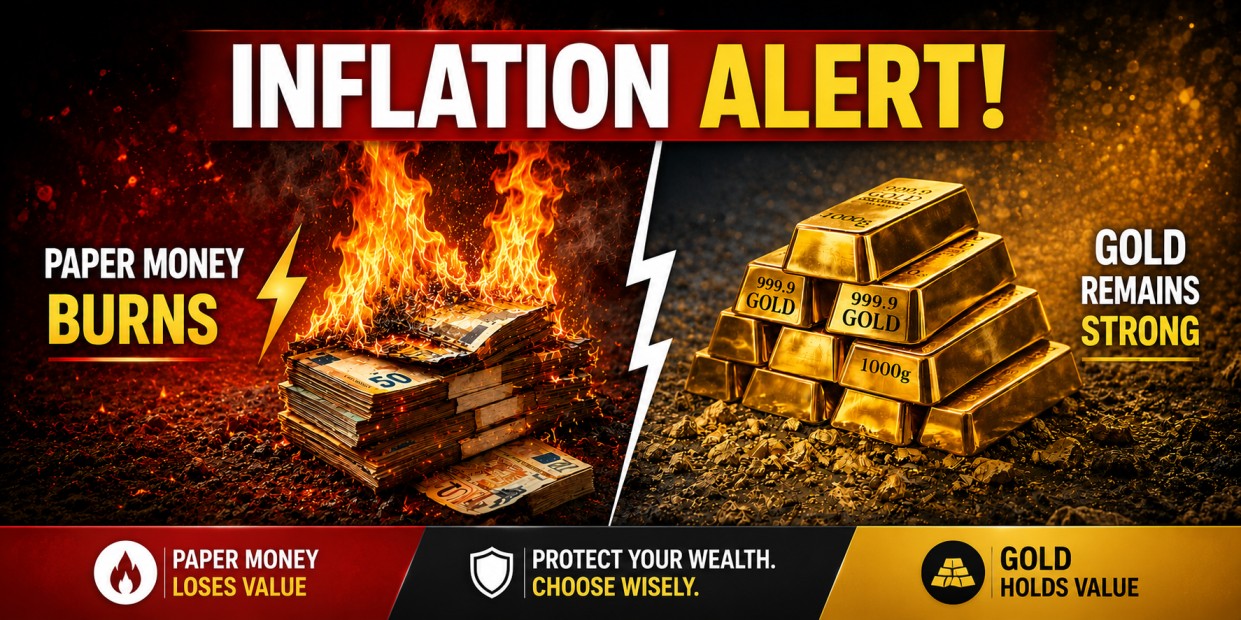
Inflation is not an abstract economic concept—it is a very real threat to the purchasing power of money. As prices rise, every dollar or euro gradually loses value. What you can buy for 100 today may cost significantly more in just a few years. For savers and investors, this means that money left unprotected or sitting idle slowly loses its worth.
1. Why Inflation Damages Your Money
Inflation occurs when more money is chasing a limited supply of goods and services. This can happen for several reasons, including expansionary monetary policy, rising government spending, supply chain disruptions, or increasing energy and commodity prices. Regardless of the cause, the result is the same: your purchasing power declines.
Inflation is particularly harmful for:
Even moderate inflation rates can have a significant long-term impact. At an annual inflation rate of 5%, money loses roughly one-third of its purchasing power within ten years. In this sense, inflation acts like a hidden tax on cash savings.
2. The Trust Factor: When Confidence in Money Declines
Currencies rely on trust. When consumers and investors begin to doubt the stability of monetary systems due to rising government debt, continuous money creation, or political uncertainty, they often seek alternative stores of value. During such periods, tangible assets become increasingly attractive—especially real estate, commodities, and above all, gold.
Unlike paper currency, gold has no counterparty risk. It is not a promise made by a government or a financial institution but a physical asset with limited availability. These characteristics make gold particularly appealing during inflationary periods.
3. Why Inflation Can Create Opportunities for Gold
Historically, gold has tended to perform well during periods of rising inflation and negative real interest rates. The reason is simple: when interest earned on savings falls below the inflation rate, traditional cash investments lose value in real terms. Although gold does not generate interest, it has preserved purchasing power over long periods. When the value of money is steadily eroding, gold often serves as a reliable store of wealth.
Several additional factors can also support higher gold prices:
Gold's strength is typically driven not by a single factor, but by the combination of inflation, uncertainty, and declining confidence in paper currencies.
4. Gold Is Not a Miracle Solution—But It Is a Valuable Part of a Portfolio
While gold can be an effective hedge against inflation, it is not a guarantee of short-term profits. Gold prices can fluctuate, sometimes significantly. During periods of rising interest rates or strong currency performance, gold may face downward pressure.
However, as a long-term stabilizing asset within a diversified portfolio, gold plays a unique role. It acts as a form of insurance against currency devaluation and broader financial system risks.
A well-balanced investment strategy does not rely solely on gold. Instead, it combines gold with productive assets such as stocks, businesses, and other long-term investments. This diversified approach helps reduce both inflation risks and market volatility.
Conclusion
Inflation is a slow but persistent threat to financial wealth. It erodes savings, weakens purchasing power, and gradually undermines confidence in currencies. In such an environment, tangible assets become increasingly important—and gold remains one of the most trusted.
While the gold price does not automatically rise during every inflationary period, long-term economic conditions often support its role as a store of value. During times of sustained inflation and uncertainty, gold continues to serve as an important tool for preserving wealth and protecting purchasing power.
Sign up today and you will be contacted by one of our experts.

Deutsches Feingoldhaus is your trusted destination for buying and selling gold bars, gold coins, silver, platinum, and palladium in Germany. We offer certified precious metals, transparent pricing, secure online ordering, and expert guidance to help you invest with confidence. Whether you're a first-time buyer or an experienced investor, we provide reliable service and quality products for long-term wealth protection.



 Login
Login Register